 Article
€8.2 Billion a Year. What Europe's Cargo Theft Numbers Tell Us About Port Security in 2026
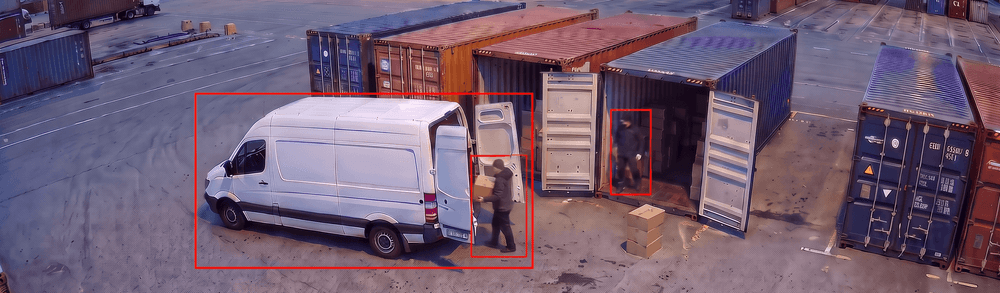
Cargo theft costs the European logistics industry an estimated €8.2 billion every year. In December 2025 alone, 557 new cargo crime incidents were reported across Europe, the Middle East and Africa, with just 100 of those cases accounting for €43 million in losses. The UK sits in the top five hotspots for these incidents, alongside Germany, Italy, France and Spain. This isn't a problem confined to one region or one type of site. It's organised, it's accelerating, and it's on our doorstep.
Two Very Different Ways In
For years, port and yard security has been built around the perimeter: fences, gates, guards, cameras pointed outward. Keep people out, and the cargo stays safe.
The data shows that assumption is only half true, and the two halves are pulling in different directions. Physical intrusion - cut curtains, forced locks, broken seals - is still the single most common method across Europe, responsible for around two-thirds of recorded incidents. But alongside that, a second and faster-growing method is emerging: criminal groups using legitimate-looking credentials, cloned companies and falsified documents to walk cargo out of facilities without breaching a single fence.
In other words, the perimeter is still under attack. But it's no longer the only route in, and the newer method is far harder to spot with traditional security.
Why Traditional Systems Only Catch Half the Picture
Most port and yard security stacks are built to answer one question: is someone where they shouldn't be? Cameras and access control handle that well, and they remain essential against the physical break-ins that still make up the majority of incidents.
But they're structurally blind to the other half of the problem: someone doing something they shouldn't, while appearing to be exactly where their credentials say they're allowed to be. That's a behavioural question, not a boundary question, and it needs a different kind of system to answer it.
This is where continuous video analytics, layered on top of perimeter security rather than replacing it, starts to matter. A system that understands what "normal" looks like for a given yard, gate, or berth can flag the things that don't fit the pattern: a container sitting in an unscheduled location, a vehicle dwelling somewhere it has no reason to be, activity happening outside an expected window. None of that trips a traditional alarm. All of it is exactly the kind of signal that precedes a loss, whichever route the thieves took to get there.
The Commercial Case, Not Just the Operational One
This isn't only a security conversation. It's an insurance and risk conversation. Rising cargo theft losses feed directly into premiums, into claims history, and into how underwriters view a given site or operator. Prevention that can be demonstrated, not just claimed, has a direct commercial value: it's the difference between a routine renewal and a difficult one.
Where This Leaves UK and European Port Operators
The industry has spent years hardening the edge of its sites, and rightly so, given how much theft still happens that way. But a growing share of losses is now coming from routes that perimeter security was never designed to see. Any operator reviewing security budgets for 2027 should be asking a specific question: would our current setup catch both kinds of loss - the break-in and the walk-out - or only one of them?
SIYTE's platform is built around exactly this gap, applying continuous, behaviour-aware video analytics across ports, terminals, and logistics sites to catch the anomaly before it becomes a claim, regardless of whether the threat came over the fence or through the gate. If you want to talk through what that looks like for your site, get in touch.