 Article
A Third of Britain's Railway Sits in a Flood Zone. Here's What Changes When You See It Coming.
A third of all track assets in Great Britain are exposed to river flood hazards, according to peer-reviewed flood risk research on the national rail network. That is not a future risk. It is the current shape of the network.
A third of all track assets in Great Britain are exposed to river flood hazards, according to peer-reviewed flood risk research on the national rail network. That is not a future risk. It is the current shape of the network.
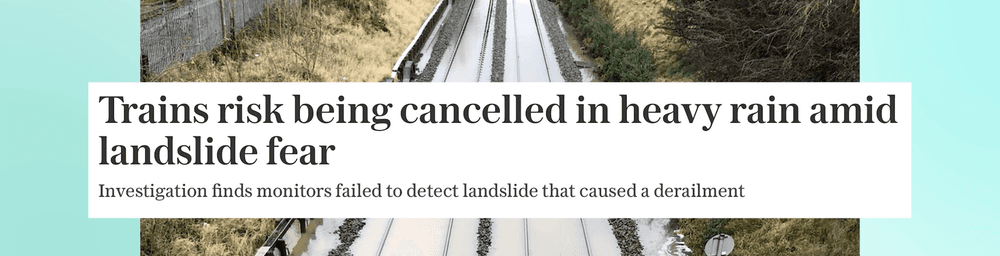
Much of the railway was built in cuttings and on low-lying land, often with drainage that was never designed for today's rainfall. When heavy rain overwhelms that drainage, ballast washes away, points and signalling can fail, and speed restrictions or closures follow. On the Marches Line, washouts from extreme weather have caused short-notice closures lasting up to seven days.
Across the network, the cost of disruption is already significant. In the year to May 2026, UK train delays and cancellations affected 37% of passengers and cost nearly 42 million hours, according to an independent analysis of Network Rail performance data. Weather, including flooding, sits alongside points failures, cable theft and trespass as one of the recognised causes behind that figure.
The question for engineering and asset teams isn't whether flood risk is real. It's how early they find out about it.
The gap between an alarm and a warning
Most flood monitoring on the railway today is threshold-based: a sensor detects that water has reached a defined level, and an alert fires. That is useful, but it is fundamentally reactive. By the time a threshold is breached, the response is already playing catch-up, a possession, a closure, a speed restriction, decided under time pressure.
A predictive approach changes the shape of that decision. Instead of waiting for a single sensor to cross a line, continuous monitoring across CCTV, environmental sensors and weather data can identify a site trending toward risk well before any threshold is reached, giving engineering teams a genuine lead time to act rather than react.
What this looks like in practice
This is not a hypothetical. SIYTE's flood monitoring deployment has already demonstrated this in practice, achieving a 20:1 return on investment within its first year by identifying rising risk early enough to avoid disruption rather than simply record it. That is the difference between a threshold alarm and genuine predictive intelligence: one tells you what has already gone wrong, the other tells you what is about to.
Why this matters for asset and drainage engineers specifically
Flood risk on the railway is rarely decided in a boardroom. It is identified, assessed and escalated by the engineers who know a specific cutting, culvert or embankment, often before it appears on anyone else's radar. Giving that person earlier, more reliable visibility of changing conditions, tied to the specific asset feeds they already work with, is where the real value sits.
If your team is looking at drainage programmes, asset renewal, or simply wants a clearer picture of where the next washout is likely to happen before it does, we'd welcome a technical discussion about what that looks like on your section of the network.